

How RFID and AI Are Transforming Linen Inventory Management for Hotels
For decades, hotels have managed linen inventory the same way: manual counts, educated guesses, and reactive ordering. The result? Chronic over or under stocking, persistent loss, and countless hours spent tracking towels and sheets instead of serving guests.
That's changing. The combination of RFID technology and artificial intelligence is fundamentally transforming how the hospitality industry manages one of its largest operational expenses through advanced hotel linen tracking systems.
The Problem: Why Traditional Linen Management Fails
Most hotels manage linen inventory using a PAR level system: maintaining a predetermined multiple of inventory based on room count. A new 200-room hotel might start with up to 6 PAR or more of towels and sheets, essentially tripling their investment to guard against uncertainty.
This approach creates several problems:
Massive Capital Investment: Hotels tie up hundreds of thousands of dollars in excess inventory "just in case." And when you multiply that by the entire portfolio, it amounts to millions of dollars.
Invisible Loss: Industry data shows hotels lose 15-20% of their linen inventory annually. Without a proper linen tracking system, operators don't know if linens are lost at the property, at the laundry, or simply miscounted.
Time Waste: Housekeeping teams spend hours each month manually counting inventory. Time that could be spent on guest-facing activities.
Vendor Accountability Gaps: When linens go missing between property and laundry, there's no clear evidence of where loss occurred, leading to disputes and strained relationships.
The traditional system isn't built on data. It's built on assumptions, worst-case scenarios, and historical norms that no longer reflect operational reality.
The Foundation: RFID Hotel Linen Tracking Technology
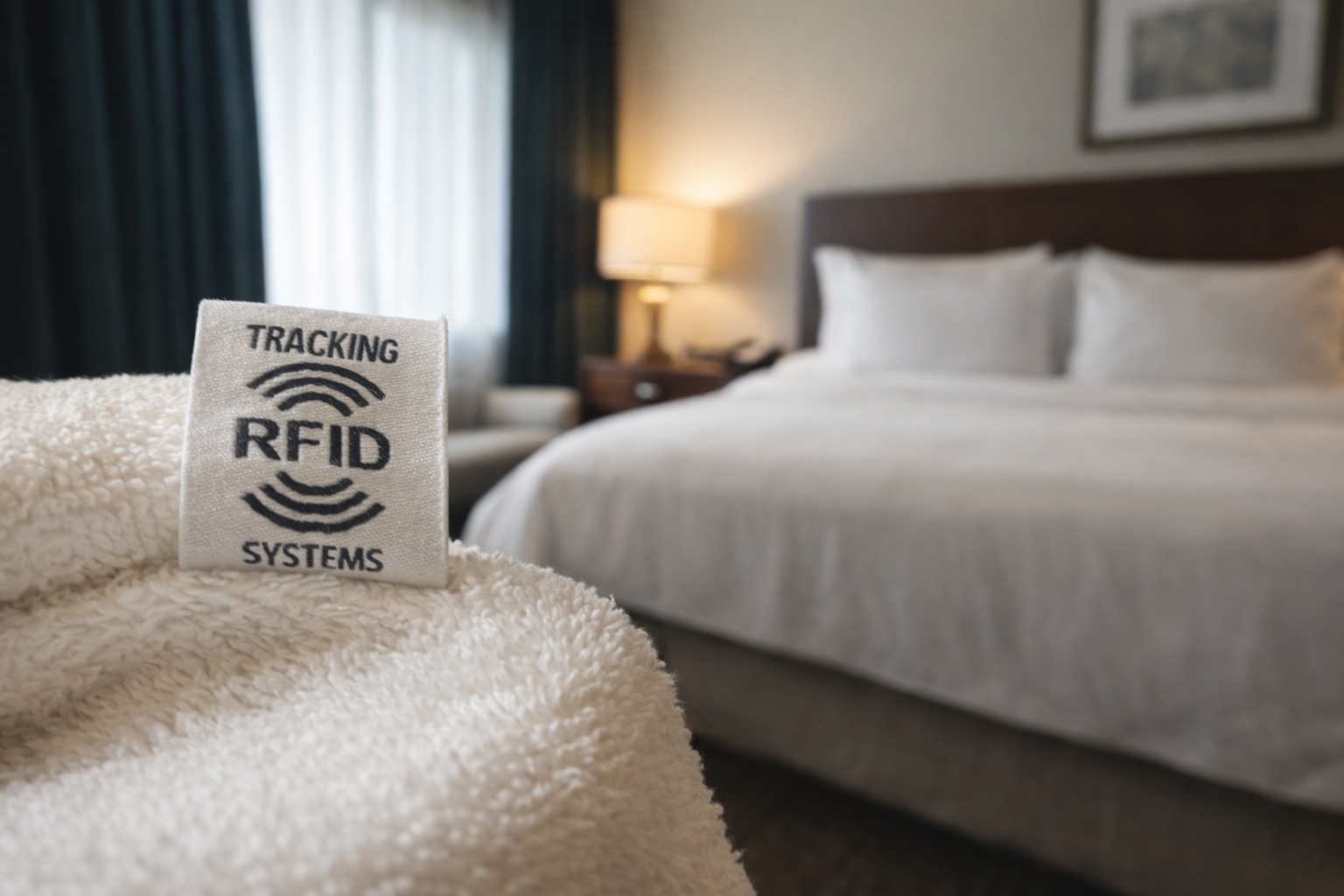
RFID (Radio Frequency Identification) linen tracking technology solves the visibility problem. Ultra-durable RFID tags are sewn directly into linens, surviving 200+ industrial wash cycles. These tags contain unique identifiers that can be scanned automatically as linens move through their lifecycle.
How hotel linen tracking works:
RFID readers are installed at key transition points: dock doors, laundry chutes, storage closets, and laundry facilities. As tagged linens pass through these checkpoints, they're automatically scanned and logged. No manual counting. No clipboards. No guesswork.
Almost immediately, hotels gain complete visibility into:
- What they own: Total inventory counts by item type
- Where it is: Real-time location tracking (property, laundry, storage, in-use)
- Movement patterns: How linens flow through the operation
This visibility alone delivers value. Hotels using RFID-based linen tracking systems report 98-99% inventory accuracy compared to 60-70% with manual counting. Unknown loss rates drop from 15-20% to 3-5% simply because items can be tracked and recovered.
But RFID linen tracking technology creates another opportunity: massive amounts of data. Every scan generates information. Every movement creates a record. Every item has a history. Without sophisticated software to process and analyze this data, operators would drown in information without gaining actionable insights.
This is where modern linen tracking systems transform raw RFID data into operational intelligence and where AI enters the picture for specific, high-value applications.
RFID-Powered Intelligence: What Smart Linen Tracking Systems Deliver
Modern linen tracking systems process RFID scan data to deliver powerful insights that were previously impossible to obtain:
1. Loss Pattern Recognition
RFID-based hotel linen tracking systems don't just count missing items. They identify where and why loss occurs.
The software analyzes loss patterns across locations, time periods, item types, and operational events. Is pool towel loss spiking on weekends? Are bath towels disappearing during turnover periods? Is a specific laundry route consistently showing higher loss rates?
The platform surfaces these patterns through automated dashboards and reports, enabling targeted interventions. Hotels can address root causes (guest education, staff training, vendor accountability) rather than simply ordering more inventory to replace what's missing.
Example: A property discovers that 80% of pool towel loss occurs at a single location: the pool deck storage closet. Investigation reveals the closet isn't being scanned properly during evening counts. Simple process adjustment eliminates the "loss."
2. Lifecycle Tracking and Optimization
Every linen item has a useful life, usually measured in wash cycles. RFID linen tracking systems track individual item history: how many washes, current circulation patterns, and age since first use.
The software tracks current rotation rates and compares it to the optimal rotation strategy defined by the property. RFID-driven lifecycle management extends average linen lifespan by 20-30%, reducing replacement costs while maintaining quality standards. Properties get more life from their assets, preserve the guest experience and get advanced warning of replacement requirements.
3. Vendor Performance Analytics
For hotels using commercial laundries, RFID linen tracking technology provides unprecedented accountability. The system tracks:
- Turnaround times by laundry facility
- Quality issues (damaged items, incorrect counts)
- Contract compliance (service level agreements)
- Last-seen location for every missing item
This data transforms vendor relationships from adversarial ("You lost our towels!" "No we didn't!") to collaborative and data-driven. Both parties see the same information showing exactly where items last scanned and can work together to reduce loss and improve service.
Example: RFID data shows 200 towels last scanned at the laundry facility 45 days ago with no return scan. The laundry investigates and finds the items mixed into another hotel's delivery. Problem solved with evidence, not accusations.
4. Real-Time Inventory Visibility
RFID hotel linen tracking software provides live dashboards showing:
- Current inventory levels by location and item type
- Circulation percentages (what's actively rotating vs. sitting in storage)
- Storage location inventory (exactly what's on each floor)
- Items below PAR levels with specific quantities needed
- 30-day loss analysis with visual trends
This visibility eliminates the need for physical counts and provides instant answers to operational questions: "Do we have enough pool towels for the weekend?" "Where are all our king duvet covers?" "Which floor is running low on hand towels?"
Where AI Adds Intelligence: Predictive Capabilities
While RFID linen tracking technology delivers unprecedented visibility and tracking, artificial intelligence takes the next step: predicting future needs and automating complex decisions.
1. Predictive Demand Forecasting
AI analyzes historical usage patterns, occupancy trends, seasonal fluctuations, event calendars, and external factors (weather, local events, booking patterns) to predict future linen needs with remarkable accuracy.
Instead of maintaining 5-6+ PAR "just in case," hotels can confidently operate with 3-4 PAR because AI forecasts when demand will spike and ensures adequate inventory is available. One hospitality group reduced opening PAR levels from 8-9 to 3-4 across their portfolio, cutting initial capital investment by more than 50% while maintaining service standards.
The AI advantage: Traditional systems might use simple averages (average daily towel usage × buffer factor). AI considers dozens of variables simultaneously and continuously refines predictions based on actual outcomes.
2. Automated Reorder Recommendations
AI-powered linen tracking systems proactively recommend what to order, how much, and when based on:
- Current inventory levels (from RFID hotel linen tracking)
- Predicted demand (AI forecasting)
- Items approaching end-of-life (RFID lifecycle data)
- Historical lead times from suppliers (learned patterns)
- Budget constraints and purchasing cycles
- Seasonal trends and upcoming events
The AI generates optimized purchase orders that balance cost, timing, and operational needs. No more emergency rush orders. No more overstocking because someone "thought we were low."
Example: AI predicts a 30% surge in towel usage for an upcoming marathon weekend three months out. It recommends ordering additional inventory now to arrive one week before the event: not too early (potential excess storage costs) and not too late (stockout risk).
3. Anomaly Detection
AI algorithms continuously monitor RFID data streams for unusual patterns that might indicate problems:
- Sudden spike in loss at a specific location
- Unexpected change in circulation patterns
- Unusual turnaround times from laundry
- Items stuck in one location for extended periods
When anomalies are detected, the linen tracking system can help identify small issues before they become major problems.
The Power of Integration: RFID + Software + AI
The real transformation comes from how these technologies work together in a comprehensive linen tracking system:
RFID provides the data: Every scan, every movement, every item tracked in real-time.
Software processes and visualizes: Dashboards, reports, analytics that turn scan data into operational insights about loss patterns, lifecycle status, vendor performance, and current inventory.
AI predicts and optimizes: Machine learning forecasts future demand, recommends optimal purchasing, and assists operators in detecting anomalies before they become problems.
Each layer builds on the previous one. RFID without software is just data. Software without AI is reactive. AI without RFID data has nothing to analyze. Together, they create an intelligent hotel linen tracking system that manages itself.
Real-World Impact: The Numbers Don't Lie
The combination of RFID linen tracking technology, intelligent software, and AI optimization delivers measurable results across multiple dimensions:
Cost Reduction: Hotels consistently reduce linen-related costs by 30-40% through optimized purchasing, reduced loss, and extended lifecycle management.
Capital Efficiency: Properties reduce initial inventory investment by up to 50%+ by moving from 6+ PAR to 3-4 PAR with data-driven confidence.
Time Savings: Automated linen tracking systems eliminate manual counting, saving 5-10 hours per week for typical properties. That time redirects to guest-facing activities.
Loss Prevention: Inventory loss drops from industry average of 15-20% to 3-5% with automated hotel linen tracking and pattern recognition.
Sustainability: Reduced purchasing, extended lifecycles, and optimized wash cycles lower environmental impact while cutting costs.
How Commercial Laundries Benefit from Linen Tracking Technology
This technology transformation isn't just for hotels. Commercial laundries gain significant advantages from RFID linen tracking systems and intelligent software:
Operational Visibility: Real-time linen tracking shows exactly what inventory is at the laundry, in-process, and ready for delivery. No more searching for lost carts or disputed counts.
Quality Control: Automated scans at processing checkpoints (receiving, washing, finishing, packing) ensure nothing gets lost in the workflow.
Customer Transparency: Shared visibility with hotel clients eliminates disputes about missing items. Both parties see the same data showing where items were last scanned.
Route Optimization: Analytics identify inefficiencies in pickup/delivery patterns and recommend optimal routing to reduce costs and improve service.
Capacity Planning: Historical data and predictive insights help laundries anticipate volume fluctuations, staff appropriately, and allocate equipment efficiently.
The result is stronger client relationships, improved operational efficiency, and data-driven evidence of service quality through advanced linen tracking technology.
Implementation: Easier Than You Think
The linen tracking technology sounds complex, but implementation is surprisingly straightforward:
For New Properties: RFID tags are sewn into linens during initial procurement. Readers are installed at key checkpoints. The hotel linen tracking system goes live immediately with minimal learning curve for staff.
For Existing Properties: Two approaches work:
- Gradual transition: Tag new inventory as old items are retired naturally
- Bulk conversion: Replace existing inventory with tagged items during a planned refresh cycle
Most properties see full ROI within a few months through reduced purchasing, recovered loss, and operational efficiency gains from their linen tracking system.
The software and AI components run in the cloud: no on-premise servers, no IT infrastructure requirements. Hotel operators receive daily email reports with actionable insights and recommendations. Mobile apps provide real-time visibility for on-the-go management.
The Bottom Line
For decades, linen management has been a necessary burden: a significant expense managed through manual processes and educated guesses. RFID linen tracking technology brought visibility. Intelligent software brought actionable insights. Artificial intelligence brought predictive power.
Together, they're transforming linen inventory from a cost center to a strategic advantage. Hotels reduce costs, improve sustainability, and redirect staff time to guest-facing priorities through advanced hotel linen tracking systems. Commercial laundries strengthen client relationships and optimize operations with linen tracking technology.
The technology is mature, the ROI is proven, and the implementation is straightforward. The question for hotel operators and laundry providers isn't whether to adopt RFID-powered linen tracking systems. It's how quickly they can implement it before their competitors do.
The future of linen management isn't manual counts and guesswork. It's automated, intelligent, and data-driven through advanced linen tracking technology. And that future is already here.
The Hidden Revenue Leak Inside Your Hotel's Linen Closet

The Laundris Experience, According to the People Who Use It Every Day
Laundris Helps Hotel Operators Save Time and Cut Costs With New AI-Powered Assistant
See the real cost of inventory inefficiency—and fix it.
Have questions or would like to learn how Laundris can help Modern your linen inventory management?
Reach out to us here.

Contact us
To schedule a demo, please complete this form and a member of our sales team will be in touch.
