

The Hidden Revenue Leak Inside Your Hotel's Linen Closet
Laundris Brings Inventory Clarity to the Costs Hotels Have Been Ignoring Since Day One
Most hotel operators can tell you their ADR to the decimal.
They track RevPAR obsessively, review comp sets weekly, and debate the ROI of lobby renovations in granular detail.
The conversation around hotel profitability tends to orbit the glamorous levers: room rate strategy, food and beverage programming, spa revenue, loyalty programs.
Meanwhile, the second-largest operating cost sits in a back-of-house cart with no tracking tag, no accountability, and no connection to the revenue decisions being made in the boardroom.
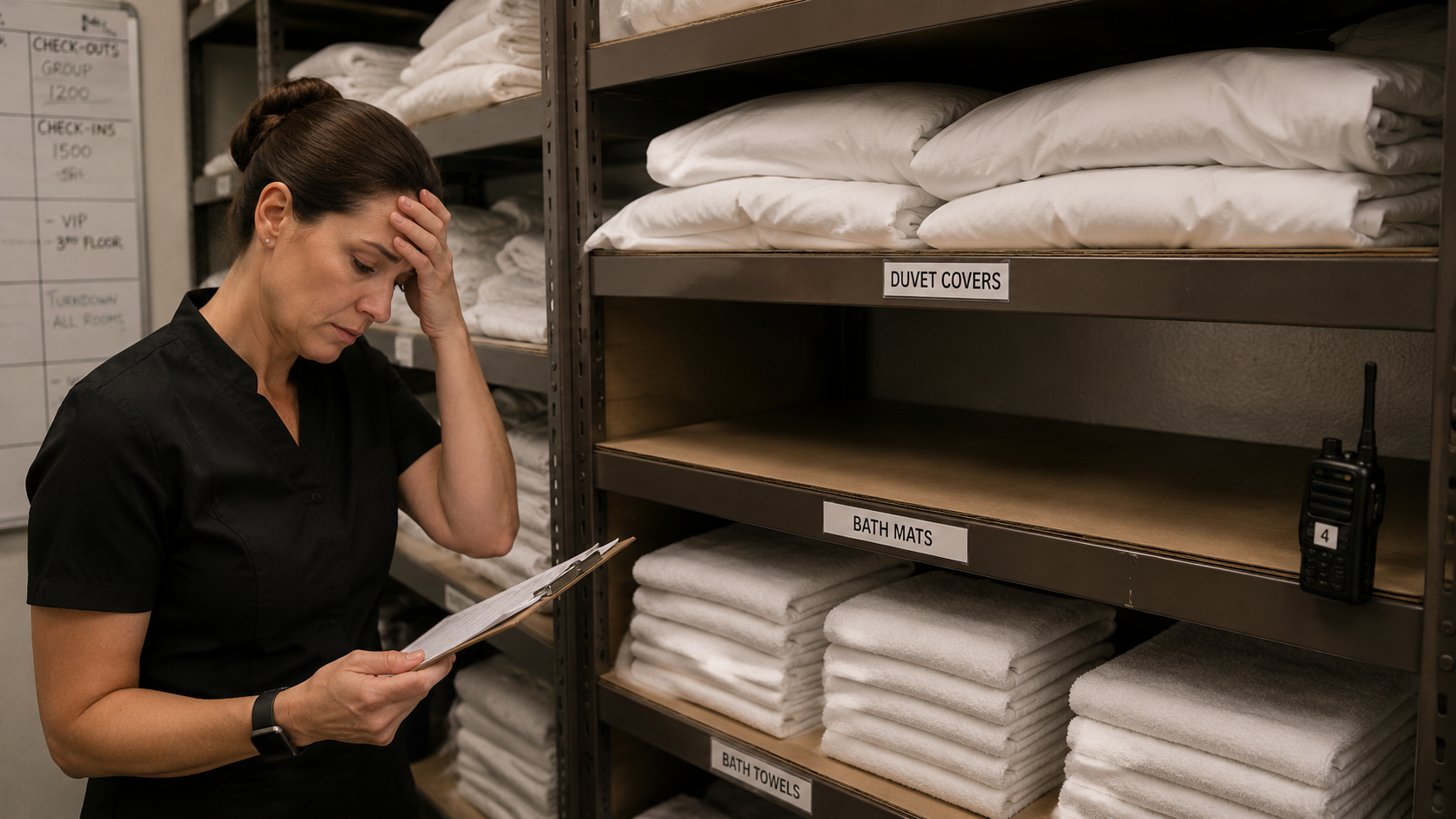
Ask a GM how many bath mats they actually have right now, where the duvet covers from last Tuesday's group checkout ended up, or how many rooms got blocked last month because housekeeping couldn't confirm they had the inventory to turn them, and the answer gets fuzzy fast.
Hotels are quietly losing inventory visibility every day, creating the same operational blind spots explored in our article on hotel linen RFID tracking.
That gap between financial precision and operational reality is exactly where Libby Clary lives. As a hospitality operations specialist and trusted advisor to hotel groups nationally, Clary has spent years sitting across the table from ownership groups, asset managers, and housekeeping directors who all share one thing in common: they're losing money in a place they've never thought to look.
The Three-Hour Window You Can't Afford to Waste
Noon checkout. Three o'clock check-in. That's the math of a sold-out hotel, and on the surface, it seems workable. Three hours to strip, clean, and remake every room on property.
Except the window isn't really three hours. It's however long it takes to locate the inventory.
"If checkout is at noon and check-in is at 3:00, that's a very limited window to be able to turn those rooms around," Clary explains. "And if they don't have the items that they need to make that happen, the stress level increases and they often aren't able to sell those rooms because they know they don't have the inventory to make them up in the time they need for the guests to arrive."
Read that again: they can't sell those rooms. Not because the hotel is empty. Not because demand is soft. Because no one knows where the king-size fitted sheets are.
At a 200-room luxury property with a $400 ADR, a single sold-out night where even 5% of rooms are blocked due to linen uncertainty is $4,000 in revenue that never hits the P&L. Multiply that across a peak season, and the number stops feeling like a housekeeping problem and starts looking like a strategy problem. Modern hotels are increasingly turning to RFID and AI to eliminate the guesswork around linen availability.
The operational chaos described here mirrors the larger issues facing modern hotel linen management systems.
Where Does the Linen Actually Go?
The easy answer is guests. The romantic-thief narrative: someone loves the monogrammed pillow shams so much that they tuck them into a roller bag. It happens. But Clary is quick to point out that guest theft is the least interesting part of the story.
"I've found many hotels that have pushed carts into unused hallways, outside of banquet halls, inadvertently moved into a storage area, and turnover behind the scenes so no one knows where that person left the last delivery," she says.
That's the unglamorous truth. Linen doesn't disappear into the night. It gets parked in a freight elevator alcove by a housekeeper who was pulled in six directions during a group checkout. It gets left on the wrong floor. It gets buried under a banquet setup that ran long. And then, when the 2:45 pm check-in rush hits, and a supervisor is sprinting through back corridors, the inventory might as well be missing.
Without tracking data, there's no way to distinguish between "linen that's in the building and retrievable" and "linen that left the building three weeks ago." Both scenarios feel identical to a housekeeping team trying to make up a room in twelve minutes.
Linen Is Your Number-Two Cost. Are You Treating It That Way?
Labor is the top operating expense at most hotels. Linen is second. That's not a fun fact from a whitepaper; that's the financial reality Clary walks ownership groups through regularly when she's making the case that this is a P&L conversation, not a housekeeping conversation.
"If you're already paying people and you have limited team, if you're then having housekeepers and other folks who maybe aren't in housekeeping trying to find where linens are, trying to turn rooms over, and realizing if there's a large event or group coming into the hotel, they aren't gonna have what they need, they then have to block those rooms and not sell them."
The compounding effect is brutal. Labor costs stay fixed whether staff is making up rooms or hunting for missing pillowcases. When a housekeeping team member is pulled from productive work to locate inventory, the hotel pays twice: once for the labor and again for the room that doesn't sell in time.
Many of these inefficiencies begin with outdated processes like manual linen counts, which consume labor while still delivering inaccurate data
Then there are the service recovery costs. "I talked to one hotelier who said if the rooms aren't ready, they are comping things, whether that's dinner at the restaurant or some other entertainment or option so that the hotel guest isn't upset about the delay." A comped dinner at a luxury property can run $150 to $300 per couple. A round of spa credits more. The root cause is a $12 bath mat that no one could find.
The Buying Problem Nobody Talks About
Here's a scenario that plays out constantly: a hotel runs low on duvet covers, panics, and places a large emergency order. The duvet covers weren't actually low. They were just temporarily invisible. Meanwhile, forty bath mats are parked on a cart behind the banquet hall.
Hidden operational waste tied to delayed room turns and emergency purchasing can dramatically increase overall linen inventory costs.
Without reliable inventory data, purchasing decisions get made on vibes and anxiety rather than actual usage patterns. And over time, that leads to exactly what Clary describes in one of her client hotels: "Way more duvet covers and way less bath mats." Both items are non-negotiable for making up a luxury room. Having a surplus of one and a shortage of the other is operationally useless.
Real data changes the purchasing equation entirely. Different linen categories have different lifecycle lengths, different replacement rates, and different cost profiles. A robe can last years with proper care. A bath mat may need to be replaced more frequently due to wear. Ordering them on the same schedule, in the same ratios, with the same budget allocation is the kind of blunt-instrument procurement that quietly and consistently erodes margins.
For ownership groups managing a portfolio of properties, the stakes scale up proportionally. Better inventory visibility means better purchasing power, better vendor negotiations, and the ability to identify which properties are bleeding linen and why.
Hotels that improve inventory visibility often uncover measurable savings through the ROI of modern linen inventory management.
How Laundris Turns Guesswork Into a Clear Daily Picture
The first thing Clary says most hotels won't admit when they're considering a platform like Laundris is that they're scared.
"Fear is what keeps them. Nobody likes change. We all want to do things the way we've always done them because that's what's working for us."
Laundris meets that resistance with a low-friction entry point: start by tagging the inventory you're already planning to order—no wholesale operational overhaul and no ripping out existing workflows on day one. Just begin collecting real data on the items coming into circulation anyway, and let the numbers do the persuading.
The impact shows up fast, and in places hotels don't expect. One property Clary works with saw morale improve. Not efficiency metrics, not laundry cycle times, but morale.
"They're not pointing fingers and placing blame on either the laundry or someone else within the team," she explains. "They're able to have clear visuals every day at their team meeting where the inventory is, where is it in the building, how soon till it comes back from the laundry so we can make up the rooms."
That daily team meeting changes character completely when there's real data on the screen. Instead of a stress spiral about what's missing and who's responsible, it becomes a logistics briefing. Here's what we have. Here's what's at the laundry and when it returns. Here's what we can confirm for this afternoon's arrivals.
The downstream effect on guests is real too. As Clary's colleague puts it: "These folks that are working behind the scenes, they want the guests to have a great experience. Giving them this tool gives them the ability to have more guest-facing time, less time running around the floors trying to find those missing pillowcases and washcloths."
A housekeeping team that finishes their day earlier, operates with less chaos, and doesn't spend their shift playing hide-and-seek with a linen cart is a team that smiles at guests in the hallway. That's not a soft metric. At a luxury property where online reviews live and die on "the staff made us feel so welcome," it's a competitive asset.
The Linen Closet Has Been Keeping Secrets
Linen inefficiency isn't a housekeeping department problem. It's a revenue management problem with a housekeeping department address. And the hotels that figure that out first aren't just running cleaner operations. They're selling rooms their competitors are blocking, comping less, burning out their teams less, and buying smarter because they finally know what they actually have.
What once felt like a housekeeping issue is now becoming a leadership priority through real-time linen accountability.
The bath mat knew where it was the whole time. The question is whether anyone was paying attention.
Stop Leaving Money in the Linen Closet
If your team spent any part of this week hunting for missing linen, blocking rooms they couldn't confirm, or comping a guest experience they should never have had to offer, the problem isn't the laundry. It's the lack of visibility.
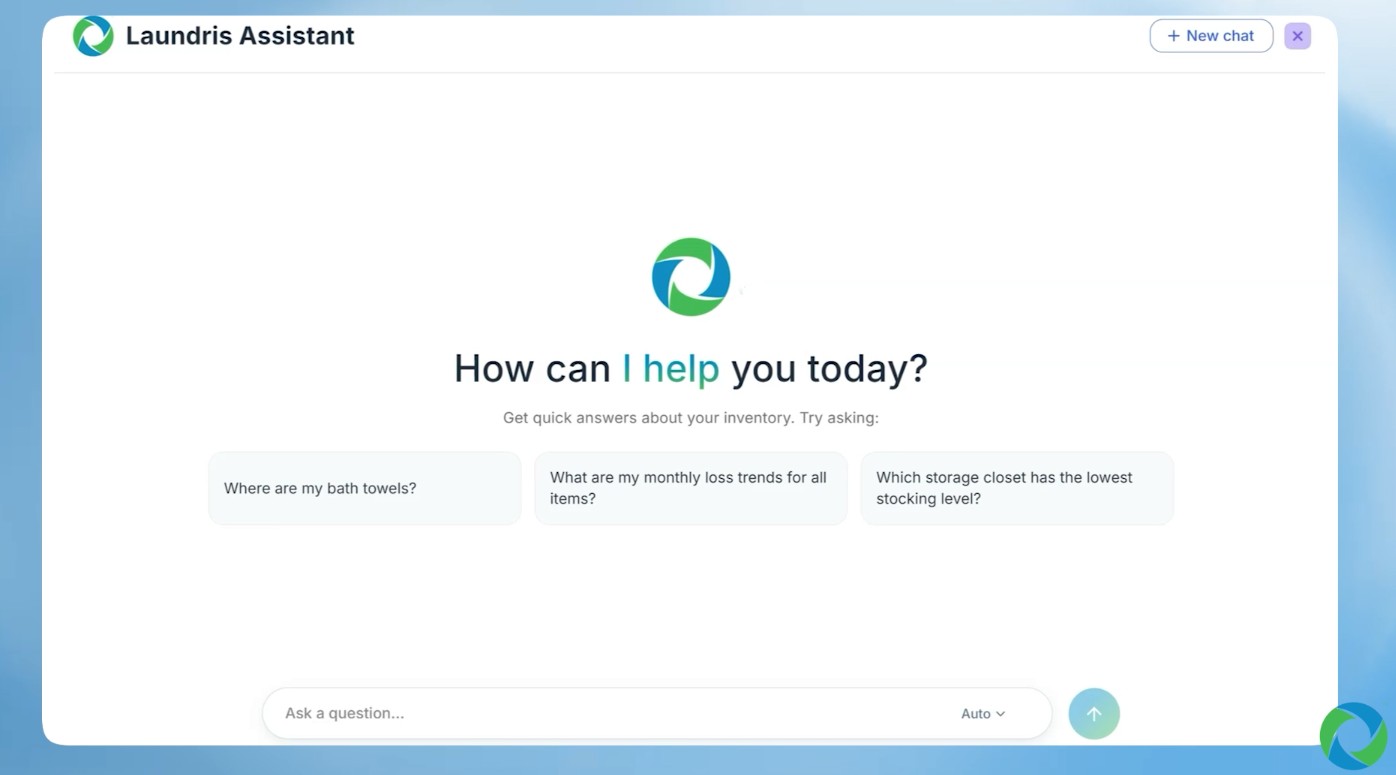
Laundris gives hotels a real-time picture of where every piece of inventory is, where it's been, and when it's coming back. No more guesswork at the morning meeting. No more rooms left unsold because no one could confirm the sheets were clean and ready.
The math on linen inefficiency is quiet but relentless. Laundris makes it loud enough to fix.
Ready to see what your inventory is actually doing? Book a linen inventory management demo >>
The Hidden Revenue Leak Inside Your Hotel's Linen Closet
.png)
Revolutionizing Inventory Management: The Future is Here with Laundris’ Autonomous Platform

The $1.5 Million Towel: What GMs Gain from Real-Time Linen Accountability
See the real cost of inventory inefficiency—and fix it.
Have questions or would like to learn how Laundris can help Modern your linen inventory management?
Reach out to us here.

Contact us
To schedule a demo, please complete this form and a member of our sales team will be in touch.
